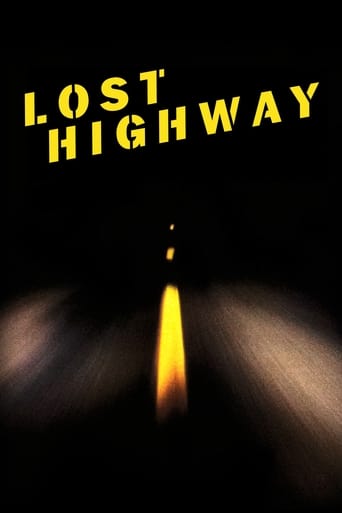
Lost Highway (1997)
A tormented jazz musician finds himself lost in an enigmatic story involving murder, surveillance, gangsters, doppelgängers, and an impossible transformation inside a prison cell.
Watch Trailer

Cast


Similar titles
Reviews
Waste of time
A Disappointing Continuation
It's an amazing and heartbreaking story.
A terrific literary drama and character piece that shows how the process of creating art can be seen differently by those doing it and those looking at it from the outside.
This movie is only for the people that values art,..and confusion. I think this is more enigmatic than Primer
There really is little point to add another review here, except well, I should for my own collection of reviews obviously have something on what I feel is STILL - probably - the best film ever made: although, oddly (like the film - odd!) initially having caught it on very first release, in a small (almost fleapit) theatre in D.C. (Washington), I got that 'what the heck was that all about?', the master has indeed lost not only his highway, but his grip / the plot! Talk about bewildered as you leave the theatre blinking into the daylight. So I empathise with any that feel this is nonsense! Ah, but wait, give it a second chance to reassess: Rather as like myself, one year on - (and pre all too soon video (DVD) home use releases) - it came on TV and having adored his earlier efforts, had to watch again to give benefit of doubt was an aberration in his oeuvre and possibly so reassess: and by which, just coincidentally, was set up to also hear, too, on the recently invested in, (then rapidly proliferating), home theatre set up sound system: and in that (aural) sense, finally, it stood- sounded - out mightily superb: since having known what was to unfold - so, knowing likely not able to make much (mundane) narrative sense to it - and so is the reason I'm adding this here, since, otherwise, really, what could I add that might be useful (new?) that hasn't already been mulled over countless times? Since otherwise, there'd really be little reason to add my take on it other than to recommend this: if you have already seen it once, then counter-intuitively, DON'T try to work it out; rather just let the images and weirdness wash over you. That's all. Indeed, even let go of the obvious movie use sense of 'viewing', so that for a change rather than intently watch, trying to work out the unlikely unworkoutable, just listen to it: the soundtrack and design (Lynch himself with long time compatriot Badalamenti) is an experience to savour on its own: as for example, as the most disturbing, (likely snuff inference?) home porn movie scene approaches, as characters career down corridors and the ominous sorta chop chop helicopter like opening bars of Ramstein's eponymous 'tune' chimes in, surreptitiously ramp up the volume on your home sound system: as the Teutonic cacophony crashes through, it'll startle and raise the hackles on ya neck even more and add to the fearful paranoia that Lynch has masterfully inveigled you into. Other than that, I wouldn't dare to try and interpret it: (Coz it's a fugue, innit? Or what?) it's best left entirely to your own impression (e.g. disjointed claptrap - or deeply disturbing take on the mysterious power of alternative personality (DID = largely dismissed Disassociative Individual Disorder?) manifestation, that may likely affect those that have power and control over us?! Opps! There, still sneaked in my take!), and just be grateful, Lynch did decide not only to put it together, but also originally for proper appreciation on on the big screen, too. (Oh, and if you have the spare time, then a must to try and triple bill it with similar themed, companion pieces, 'Mulholland Dr.' and 'Inland Empire'.)Truly masterful from a cinematic genius master: there, that's my take / recommendation done.
Lost Highway finds Lynch just as confused as his audience. He exploits Patricia Arquette to no end, showing us her naked body as though it were a Star Wars special effect every few minutes. As a feminist accidentally born with testicles, I found this very offensive. Furthermore, I couldn't help but feel this movie has a conservative message underneath all the flash and weirdness. When we see Patricia Arquette on a movie screen, in a porno film, near the end of the movie, a harsh, seeming gregorian chant from a Ramstein song (and let's not pretend we don't know what THOSE GUYS represent..,) plays on the soundtrack. In an almost Spielbergian gesture of fascist filmmaking, the audience is forced to find something negative in a woman's choice to do with her body what she wants. Shame on you, Mr. Lynch!When you pull apart the pieces of Lost Highway and examine them, the movie doesn't make much sense, I'm afraid to say. I'm one of those people who loves to claim that, "If you didn't like it, you didn't get it!" But I'm afraid here, I can't defend modern art with that old standby. The fact of the matter is, Mr. Lynch's warmup for his masterpiece, Mulholland Dr., is an emperor with no clothes.
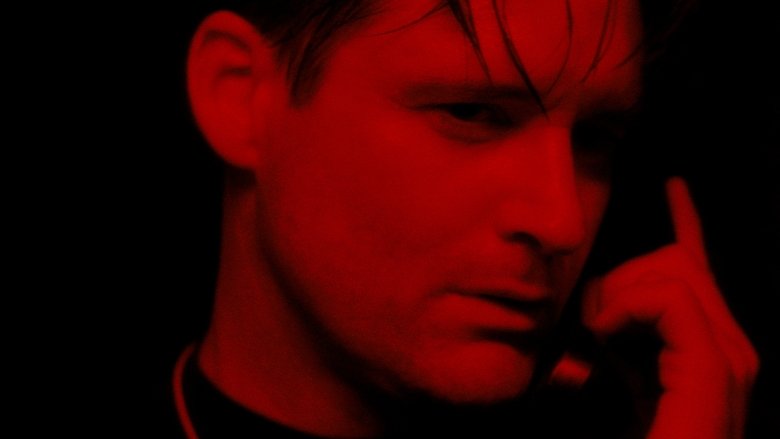
Fred Madison (Bill Pullman) is told that "Dick Laurent is dead". He plays the saxophone. He and his wife Renée (Patricia Arquette) are hounded by someone unknown. A mystery man, supposed to be a friend of Dick Laurent, meets Fred at a party. Fred is jailed for brutally murdering Renée. In prison, his identity changes to Pete Dayton (Balthazar Getty). Pete is released for being the wrong guy. Sheila (Natasha Gregson Wagner) is his girlfriend. He's a mechanic working at a garage owned by Arnie (Richard Pryor). Gangster Mr. Eddy (Robert Loggia) needs his car repaired and Alice Wakefield (Patricia Arquette) is his mistress.David Lynch has made something confusing. Following this logically may be a fool's errant. The problem is that it's not terribly compelling either. It grinds along like a car stuck in first gear. It is impossibly slow with an unknowable story. When the switch happens, the movie goes into a WTF restart. I'm not sure I care about the first part. At least, the second part has the great Robert Loggia.